
9 minutes
[Russian Law] Ombudsman challenges the anti-NGO law at the Constitutional Court
Mr. Dobrovodský (Slovak Ombudsman) protests against the discriminatory nature of the law approved by the coalition and signed by President Pellegrini. According to the Ombudsman's motion, certain parts of the law undermine the principle of freedom, prevent civil society from participating in public life, and introduce disproportionate state intervention that enables "spying."
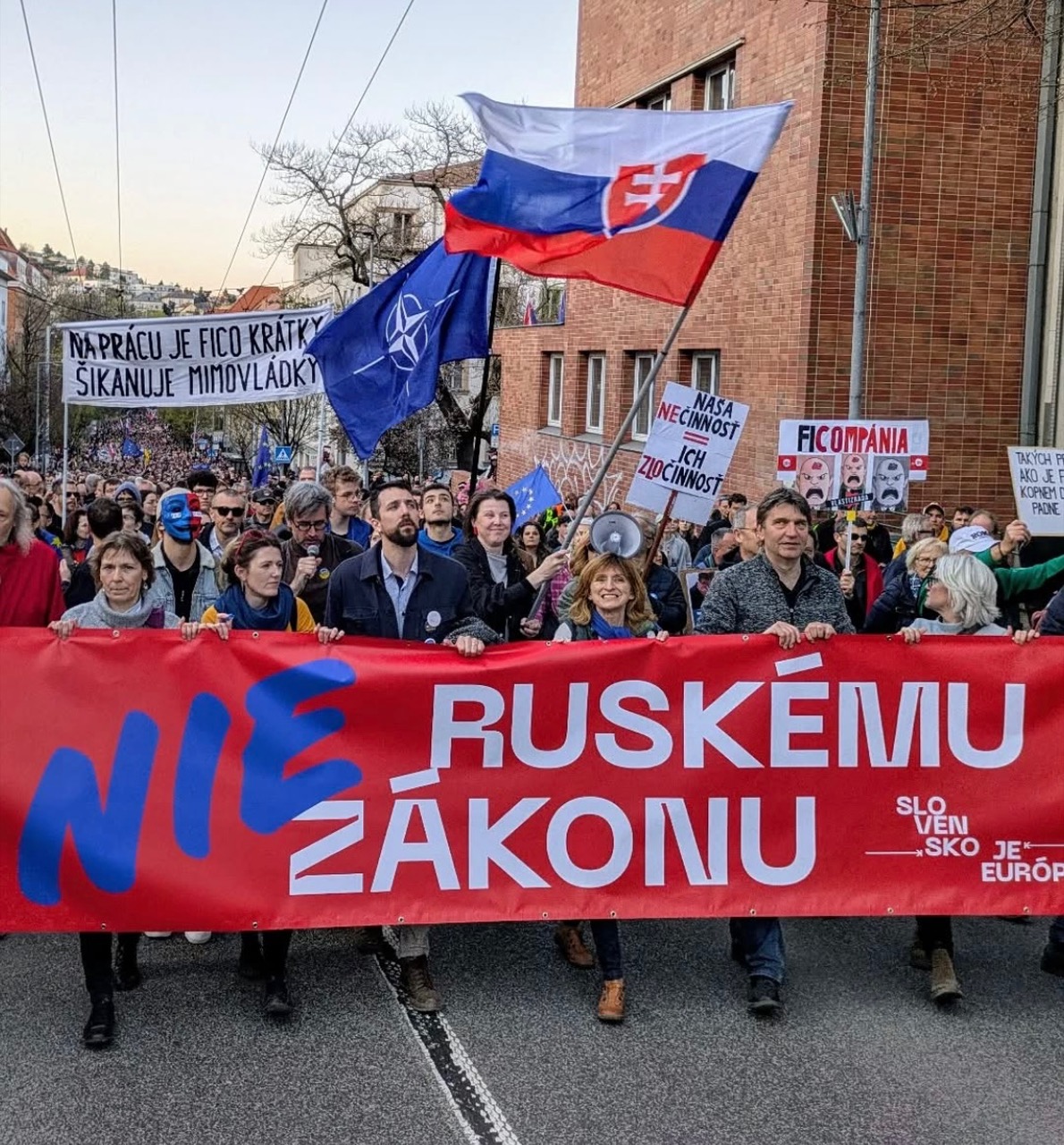
The anti-NGO ("Russian law") - a 16 April amendment (Act No. 109/2025 Coll.) - to Act No. 213/1997 Coll. on Non-profit organisations providing services of general interest, after a 7 May signature of President Pellegrini, entered into force on 1 June 2025.
#OMBUDSMAN CHALLENGES ITS CONSTITUTIONALITY
Mr. Róbert Dobrovodský, Slovak Ombudsman (Public Defender of Rights - Verejný ochranca práv), immediately after President's signature declared his intention (on 7 May, his Facebook page, in Slovak) to challenge the adopted amendment.

Mr. Dobrovodský: Russian law is unticonstitutional. (Image creation: VIA IURIS, LinkedIn account)
On 15 August, he in the title informed that "I officially announced the submission of a motion to the Constitutional Court of the Slovak Republic requesting a review of the compliance of Amendment No. 109/2025 Coll. on non-governmental organisations with the Constitution of the Slovak Republic.
The motion also challenges the amendment's compliance with international conventions, specifically the Convention for the Protection of Human Rights and Fundamental Freedoms and the Charter of Fundamental Rights of the European Union. The challenged provisions impermissibly and disproportionately restrict the fundamental rights and freedoms of natural and legal persons."
As it was further stated concerning the law, "some parts of it undermine the principle of freedom, prevent civil society from participating in public life, and introduce unreasonable state intervention allowing for "spying"."
While the full motion is available on the Ombudsman website, he also offered 5 key objections:
1. Disclosure of contributors and protection of privacy
The amendment to the law requires foundations, non-investment funds, and non-profit organizations to disclose the identification details and contribution amounts of all donors, which I believe is an unreasonable interference with the right to privacy and anonymity. This change threatens freedom of expression and freedom of association, as potential donors may feel constrained by public scrutiny, which ultimately weakens their freedom of choice in supporting non-profit organizations.
2. Restriction on the free movement of capital
The obligation to disclose information about contributors, including donations from abroad, may restrict legitimate support for Slovak non-governmental organizations engaged in activities for the public benefit. This regulation is contrary to the principle of free movement of capital under Article 63(1) of the Treaty on the Functioning of the European Union, as confirmed by the case law of the Court of Justice of the European Union, which considers such restrictions to be a violation of this fundamental right.
3. Extension of the scope of the Freedom of Information Act
One of the controversial points is the inclusion of non-governmental organizations among the entities subject to the Freedom of Information Act if they exceed a certain threshold of income from public sources. I argue that this extension of scope could lead to excessive bureaucracy and restrictions on the activities of organizations that are important to society. These controversial points do not respect the principle of minimizing interference with fundamental rights and freedoms. At the same time, such interference is not necessary in a democratic society. There are three reasons for this:
a) The provider of public funds to non-governmental organizations is already an obligated entity, and information about the amount, purpose, and fulfillment of the conditions of the subsidy, contribution, or other payment provided can be obtained through this body without non-governmental organizations being classified as obligated entities,
b) Public funds are provided by public institutions to non-governmental organizations on the basis of purpose-bound contracts, whereby the relevant public institutions have both the obligation and the authority to monitor compliance with the contractual conditions for the use of the public funds provided. Public institutions are then obliged to make this information available in accordance with the Freedom of Information Act, enabling the public to learn about the management of public funds provided to non-governmental organizations, without imposing an excessive administrative burden on non-governmental organizations and, above all, without transferring the exercise of public power to these private entities,
c) All contracts for the provision of subsidies or contributions from public sources are, within the meaning of the Freedom of Information Act, contracts that are subject to mandatory disclosure and are freely and collectively accessible in the Central Register of Contracts.
4. Shortcomings in personal data protection
I would like to point out that the amendment to the law does not sufficiently specify the purpose and scope of personal data processing by state authorities and does not introduce any safeguards for the protection of this sensitive data. This creates room for potential misuse and violation of the fundamental right to personal data protection.
5. Accumulation of income and statutory functions
The amendment introduces the controversial presumption of accumulation of income if a statutory body is active in several non-governmental organizations. According to the Public Defender of Rights, such a provision may unduly restrict the freedom of individuals and may lead to discrimination and unnecessary administrative burdens.
The contested legislation has a relatively harsh impact on small civic associations and international organizations whose annual income does not reach EUR 35,000. A statutory representative or member of a statutory body may thus be discouraged by the contested legislation from holding a similar position in another non-governmental organization under the threat that this would result in extensive obligations for all non-governmental organizations in which he or she would hold such a position.
The presumption of income accumulation in this case imposes the same obligations on small organizations with an annual income of only a few thousand euros as on large non-governmental organizations, which theoretically have greater flexibility in fulfilling the obligations imposed by the contested law.
#CIVIL SOCIETY OBJECTIONS (March-April 2025)
The anti-NGO ("Russian law"), has been a long-standing subject initiated by the Slovak National Party (SNS) parliamentary members in March 2024 (see chronology below) and may mean a disproportionate interference in the privacy of active citizens, and a significant administrative burden for civil organisations.
The main objections of NGOs to various versions of the amendments were processed by VIA IURIS (in Slovak) - in its initial analysis (28 March 2025) as well as explanations of the Government Office (2 April 2025), and were summarised in our 14 May article (also in articles from 21 March, 3 April, 16 April and 7 May 2025 - all these in Slovak).
#STATEMENT OF THE PLATFORM FOR DEMOCRACY (May 2025)
Platform for Democracy, a forum that bring together numerous Slovak civil society organisations, including MEMO 98, on 7 May 2025 expressed disappointment at the decision of President Pellegrini to sign the law.
"We are disappointed by the President's attitude, who has been approached by a number of helping - social, charitable, health and education platforms and organisations, as well as local government and public administration leaders, with concrete examples of how the law signed today bullies and threatens them. Ultimately, the negative consequences of this unnecessary law will be borne by the citizens who use the services of NGOs today," said Filip Vagač, Programme Director of the Platform for Democracy.
The Platform for Democracy remains convinced that the legal norm in question is unconstitutional and contrary to European Union law.
"Today we appeal to all those who have the power to appeal to the Constitutional Court, especially to the MPs of the National Assembly and the Public Defender of Rights, to use their right to have the law assessed by the Constitutional Court," added Filip Vagač.
In this context, the Platform for Democracy expresses its gratitude to all platforms, organisations and individuals who have engaged in activities against the "Russian law" and, based on the experience from Hungary, expresses its hope that the legal norm will be stopped in the next steps by the Slovak or European courts.

#CHRONOLOGY
Beginning: The bill was submitted to the parliament on 27 March 2024
Proposers: Milan Garaj, Rudolf Huliak, Dagmar Kramplová, Adam Lučanský (at that moment all represented Slovak National Party [SNS - Slovenská národná strana])
Steering Parliament Committee: Constitutional Committee, Chaired by Miroslav Čellár (HLAS-sd)
Rapporteur: Richard Glück (SMER-ssd)
Voting: Present - 132 MPs | FOR (za) - 76, AGAINST (proti) - 55, ABSTAINED - 0, DIDN'T VOTE - 1
Law (full version in Slovak): Act No. 213/1997 Coll. on Non-profit organisations providing services of general interest