
5 minutes
Media coverage of elections: nine practical training modules
Developed by Rasťo Kužel for the Council of Europe, for media regulators, journalists, election observers and civil society organisations.
Drawing on 20 years of training experience, the programme combines practical methods and case studies on election coverage with guidance on current challenges, including disinformation, AI-generated content and online political advertising.
Fair election coverage helps voters make informed choices, hear different perspectives and scrutinise those seeking public office. Ensuring this requires attention to established questions of fairness, pluralism and editorial independence, alongside current challenges such as disinformation, AI-generated content and online political advertising.
To support this work, MEMO 98’s Rasťo Kužel has authored the Council of Europe’s training programme on Media Coverage of Elections, drawing on his extensive practical experience in media monitoring and election observation, alongside 20 years of conducting training with the organisation. The programme connects European standards with real cases and the everyday decisions facing those who report on, monitor and regulate electoral communication.
Each of the nine modules combines a presentation, participant exercises and guidance for trainers. The materials can support a complete programme, focused workshops or training of trainers, with content and delivery adapted to participants’ professional experience and national circumstances. Discussion, practical cases and shared experience are central to the approach.
The Trainer’s Guide introduces the programme’s objectives, structure and methodology, with guidance on selecting modules, adapting the training to national contexts and using the materials for training of trainers.
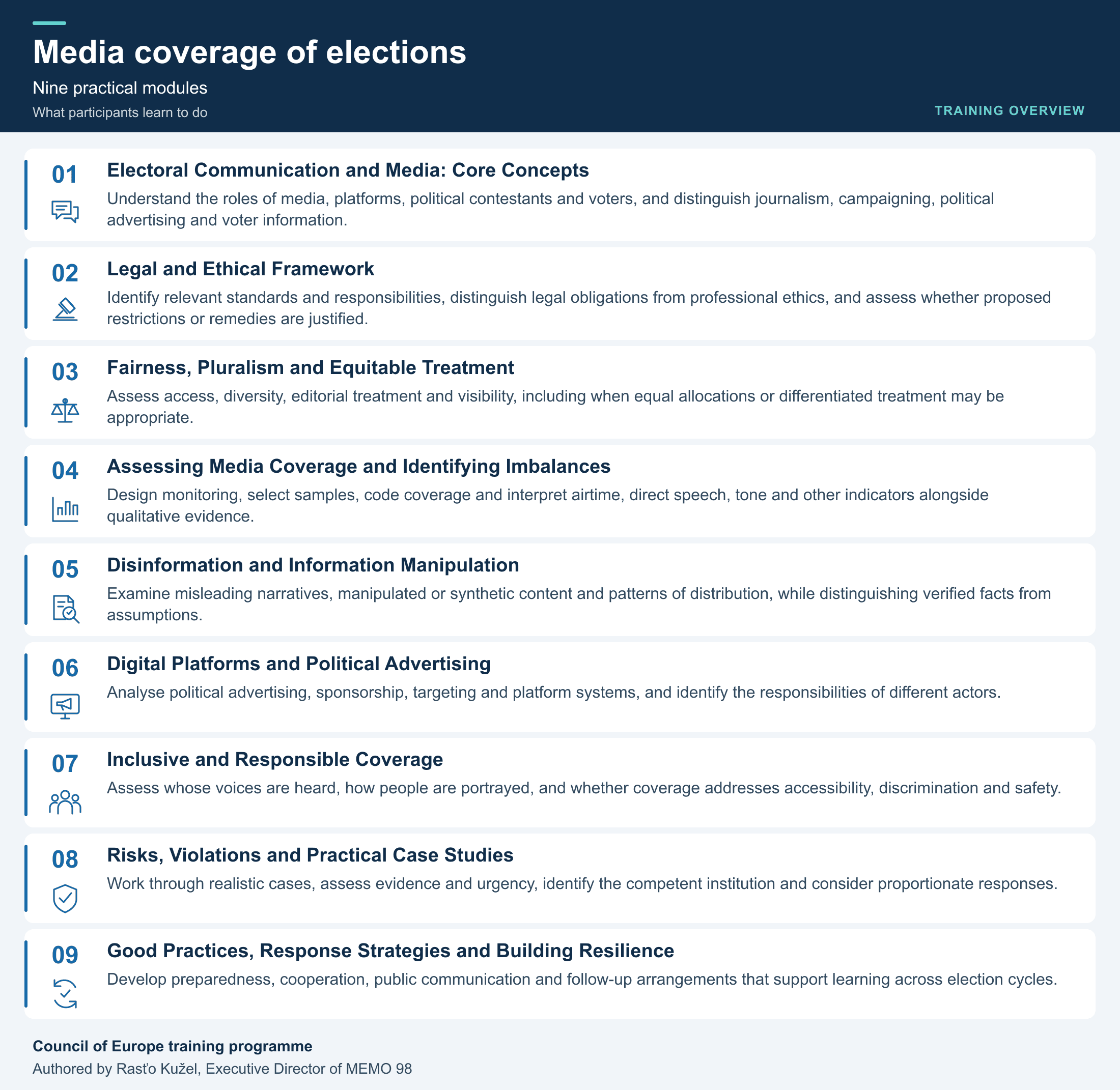
#1. Electoral Communication and Media: Core Concepts
The opening module explores how media, platforms, political contestants and voters shape electoral communication. Participants learn to distinguish journalism, campaign messages, political advertising and voter information, and examine how editorial choices and online distribution influence what voters see. It provides the foundation for the modules that follow.
#2. Legal and Ethical Framework
This module connects freedom of expression, editorial independence and the right to free elections. Through practical dilemmas, participants distinguish legal obligations from professional ethics, identify the responsibilities of different institutions and assess whether proposed restrictions or remedies are justified and proportionate.
#3. Fairness, Pluralism and Equitable Treatment
This module examines what fair coverage means in news, interviews, debates and other formats. It considers when equal allocations or differentiated treatment may be appropriate, how smaller and new contestants can receive meaningful opportunities, and how prominence, framing and incumbency advantages affect the information available to voters.
#4. Assessing Media Coverage and Identifying Imbalances
Participants learn how to design media monitoring, select samples and apply consistent coding rules. The module combines quantitative indicators—including airtime, direct speech and the tone of coverage—with qualitative analysis. It also explains how to interpret findings, recognise limitations and produce recommendations supported by evidence.
#5. Disinformation and Information Manipulation
This module addresses misleading narratives, coordinated amplification and manipulated or AI-generated content, including deepfakes. Participants examine how information spreads, assess potential harm and distinguish verified facts from assumptions about intent or responsibility. Practical cases help connect detection and verification with timely responses that respect freedom of expression.
#6. Digital Platforms and Political Advertising
The focus is on how platform systems and paid political advertising shape electoral visibility. Participants examine sponsorship, funding, targeting and transparency, asking who is behind a message and how it reaches its audience. The module also clarifies the different responsibilities of platforms, advertisers and public authorities.
#7. Inclusive and Responsible Coverage
This module examines whose voices are heard, how people are portrayed and whether election information is accessible to different audiences. It addresses underrepresentation, stereotypes, gendered disinformation, discrimination and safety, helping participants identify barriers to participation and develop practical editorial, monitoring or institutional responses.
#8. Risks, Violations and Practical Case Studies
Participants bring the earlier modules together through realistic cases involving media coverage, advertising, disinformation and harassment. They assess evidence and urgency, distinguish ethical concerns from legal violations, identify the responsible institution and consider appropriate remedies. The emphasis is on making defensible decisions under practical constraints.
#9. Good Practices, Response Strategies and Building Resilience
The final module turns analysis into preparation and sustained improvement. Participants develop arrangements for cooperation, public communication and incident response, translate monitoring findings into actionable recommendations and identify lessons for future elections. It emphasises clear responsibilities and learning across the electoral cycle.
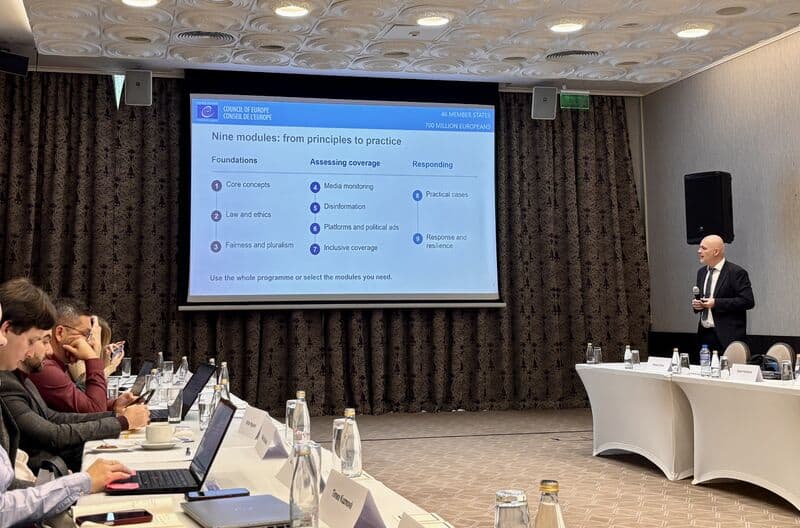
Rasťo Kužel presenting the Council of Europe’s training programme on media coverage of elections in Podgorica, 19 November 2026.
#Tailored training and cooperation
Rasťo Kužel will be happy to explain the programme and answer any questions or enquiries, including about tailored workshops, training of trainers, and support with media-monitoring methodology. Sessions can focus on selected modules and the specific challenges facing an organisation or country. For enquiries or potential cooperation, contact kuzel@memo98.sk.
Download the complete training programme on Media Coverage of Elections, including the Trainer’s Guide and all nine modules in one document. Conditions for using the materials are available on the Council of Europe website.