
6 minutes
Your Digital Safety: A New MEMO 98 Guide for Women in the Public Sphere
In this new practical guide, we offer recommendations for protecting yourself from online harassment, gendered disinformation, and manipulative attacks in the digital space.
Online attacks, coordinated hate campaigns, and the publication of personal information are becoming an increasingly common part of the digital environment. Women in public life - journalists, politicians, activists, and experts - are often targeted by attacks that are not aimed at genuine debate, but at intimidation, discrediting, and pushing them out of public discussion. This is why we prepared a new practical guide offering concrete recommendations for responding safely, protecting privacy, and strengthening digital resilience against online attacks and gendered disinformation.
Online attacks, coordinated hate campaigns, the publication of personal information, and manipulative narratives targeting women have become an increasingly common part of the digital space in recent years. These attacks are not simply “heated debate” or disagreement. Many have a single goal: to undermine credibility, create fear, exhaust, and push women out of the public sphere.
MEMO 98 has therefore prepared a new practical guide:
Your Digital Safety: How to Protect Yourself from Online Harassment, Manipulative Attacks, and Gendered Disinformation.
The guide was created as part of the Fighting gendered disinformation online project and aims to provide clear and practical recommendations for women active in public life, visible online, or facing hateful and manipulative attacks.
Download the guide “Your Digital Safety” (PDF)
Read the research report “Online Gendered Disinformation and Politicised Gendered Abuse in Slovakia and Czechia” (PDF)
#Visibility should not mean vulnerability
Gendered disinformation often disguises itself as humor, criticism, or “just an opinion.” In reality, however, it is not about legitimate debate, but about attacking a person’s dignity, identity, and right to participate publicly. These attacks target not arguments, but appearance, voice, motherhood, sexuality, and stereotypical ideas about what a woman “should be.”
The goal of such attacks is not to win an argument, but to undermine credibility and discourage women from participating in public life. That is why the publication combines broader context with practical recommendations that can help protect accounts, privacy, mental well-being, and crisis management.
#What you will find in the guide
The publication addresses several areas of digital safety and responses to online attacks - from identifying manipulative campaigns to practical recommendations on how to respond safely and thoughtfully.
The guide also includes practical checklists, decision-making schemes, and visual guidance.
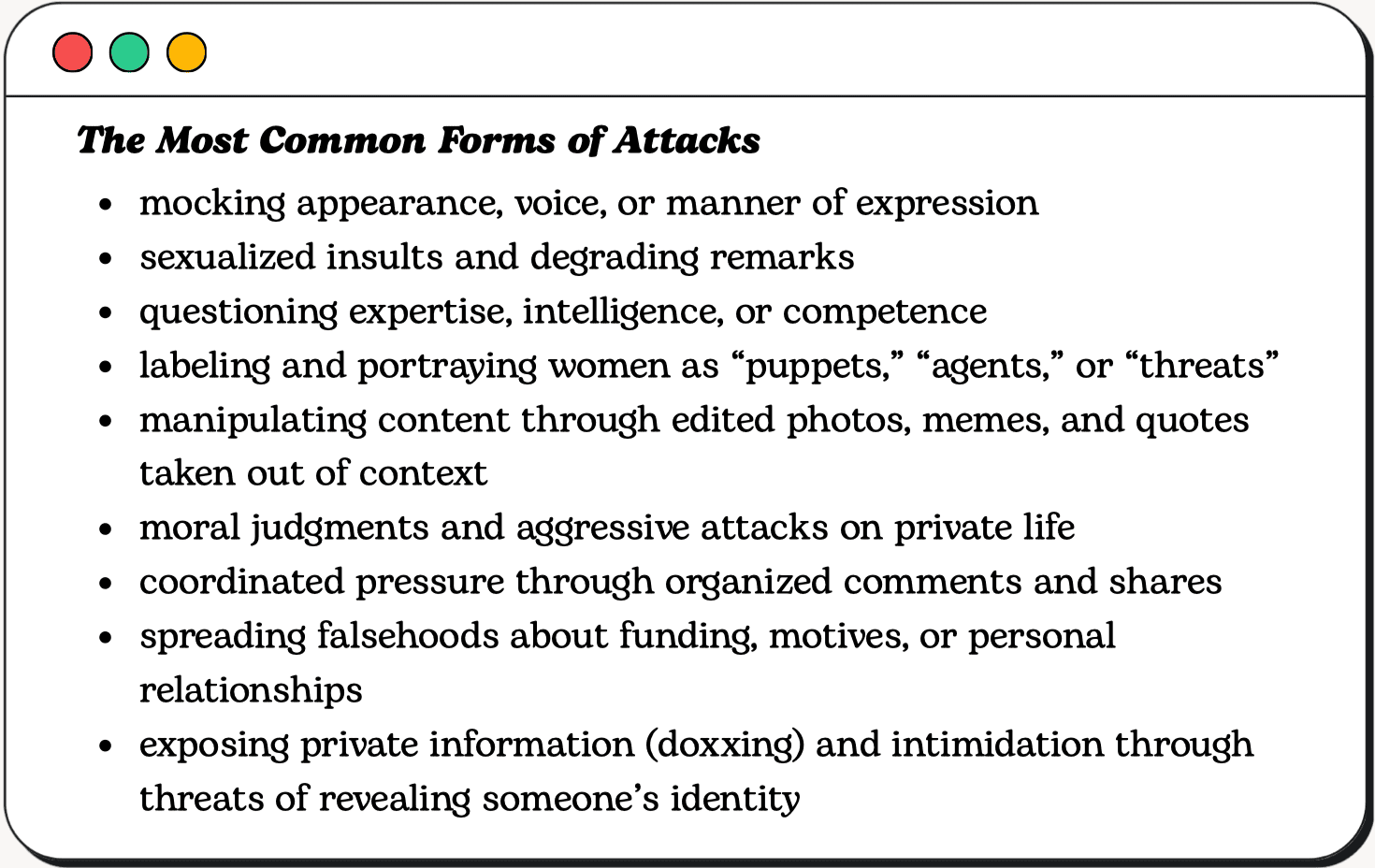
For example, the section on the most common forms of attacks shows how online violence can include ridicule of appearance, sexualized insults, questioning of expertise, coordinated campaigns, and the publication of personal information.
Another section explains warning signs of coordinated attacks - such as sudden waves of similar comments, identical wording across multiple accounts, or attempts to create fear and silence instead of discussion.
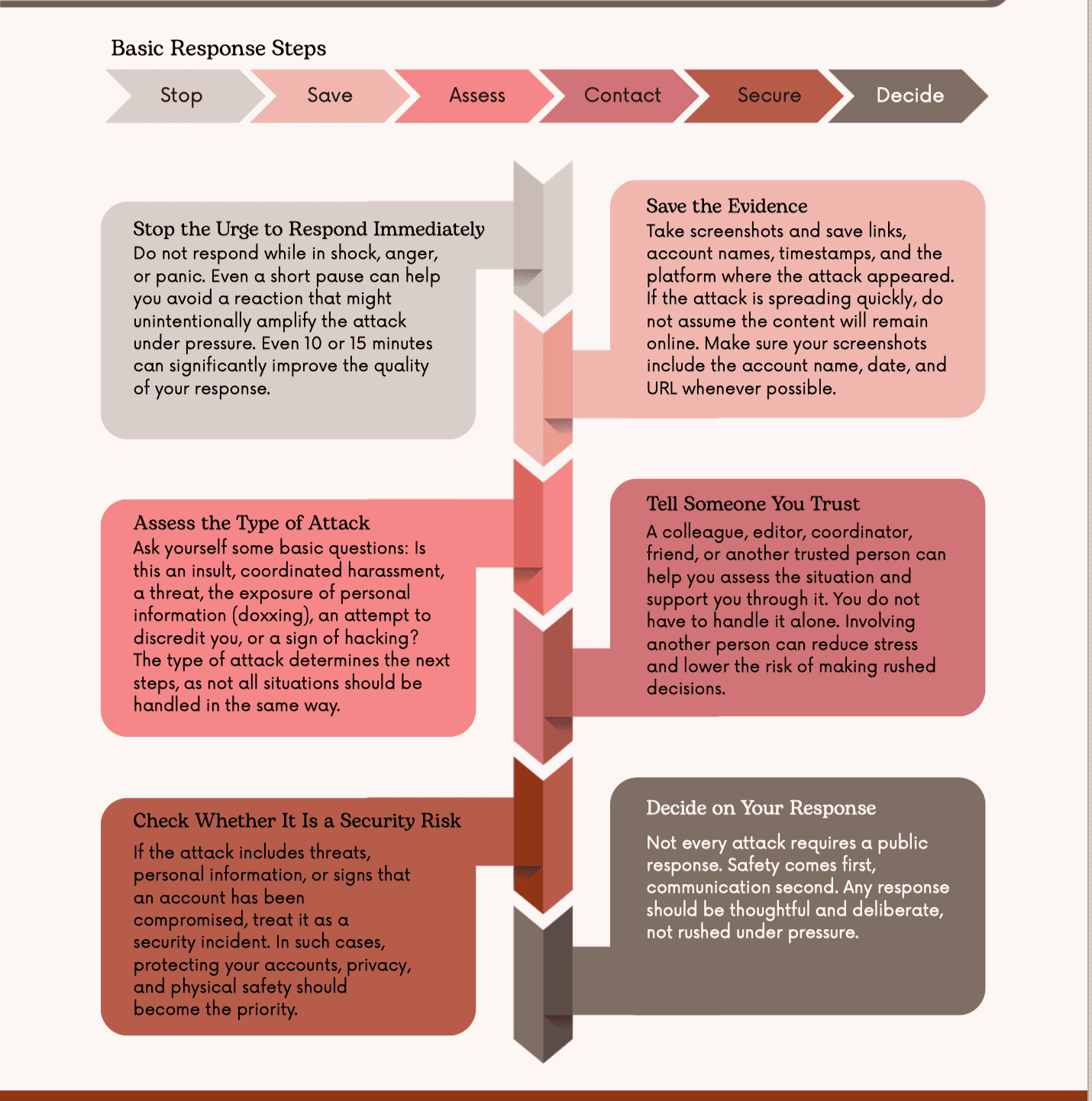
The guide also provides practical advice on what to do in the first minutes after an attack: avoid impulsive reactions, save evidence, assess risks, and involve a trusted person or team.
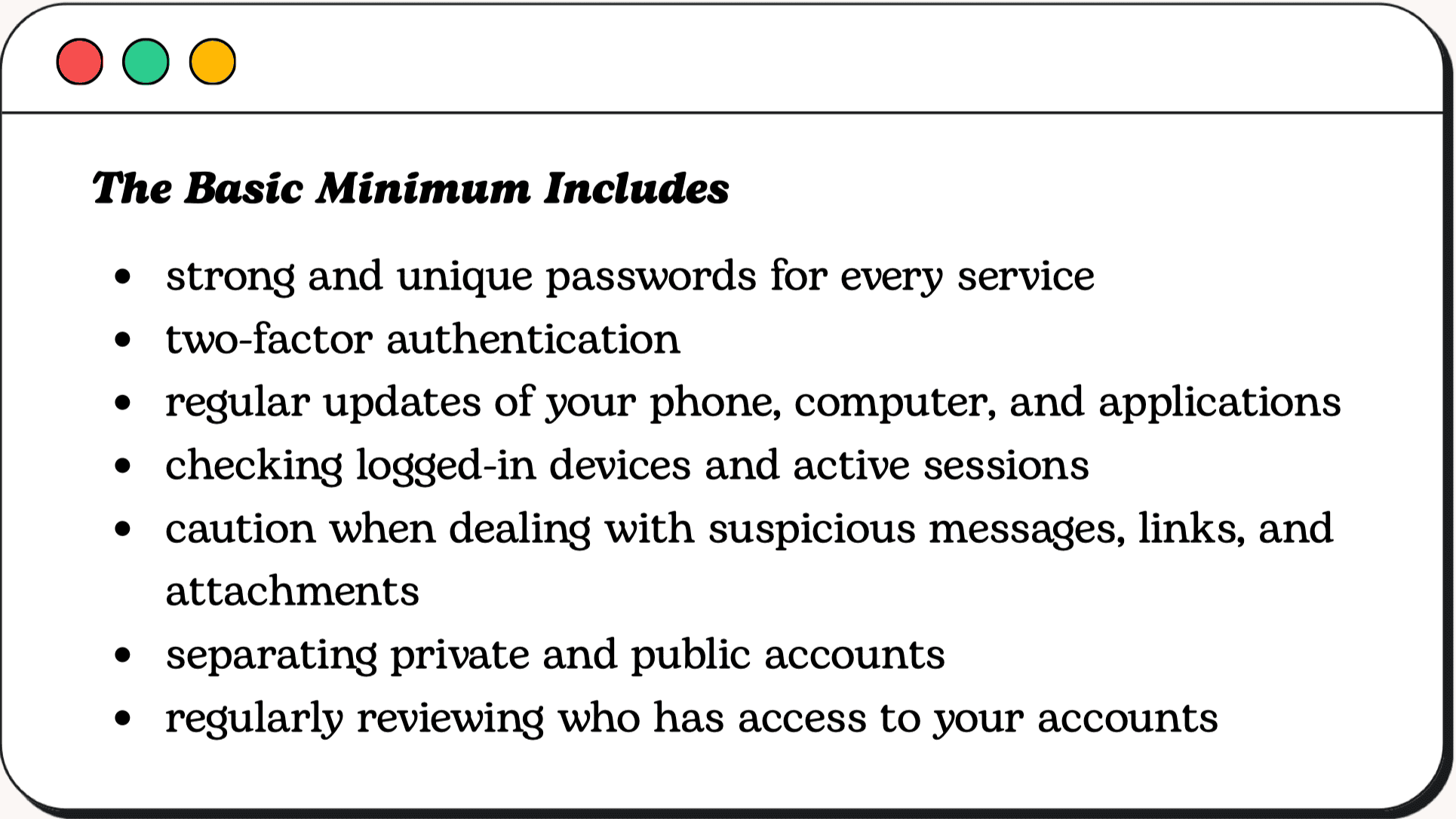
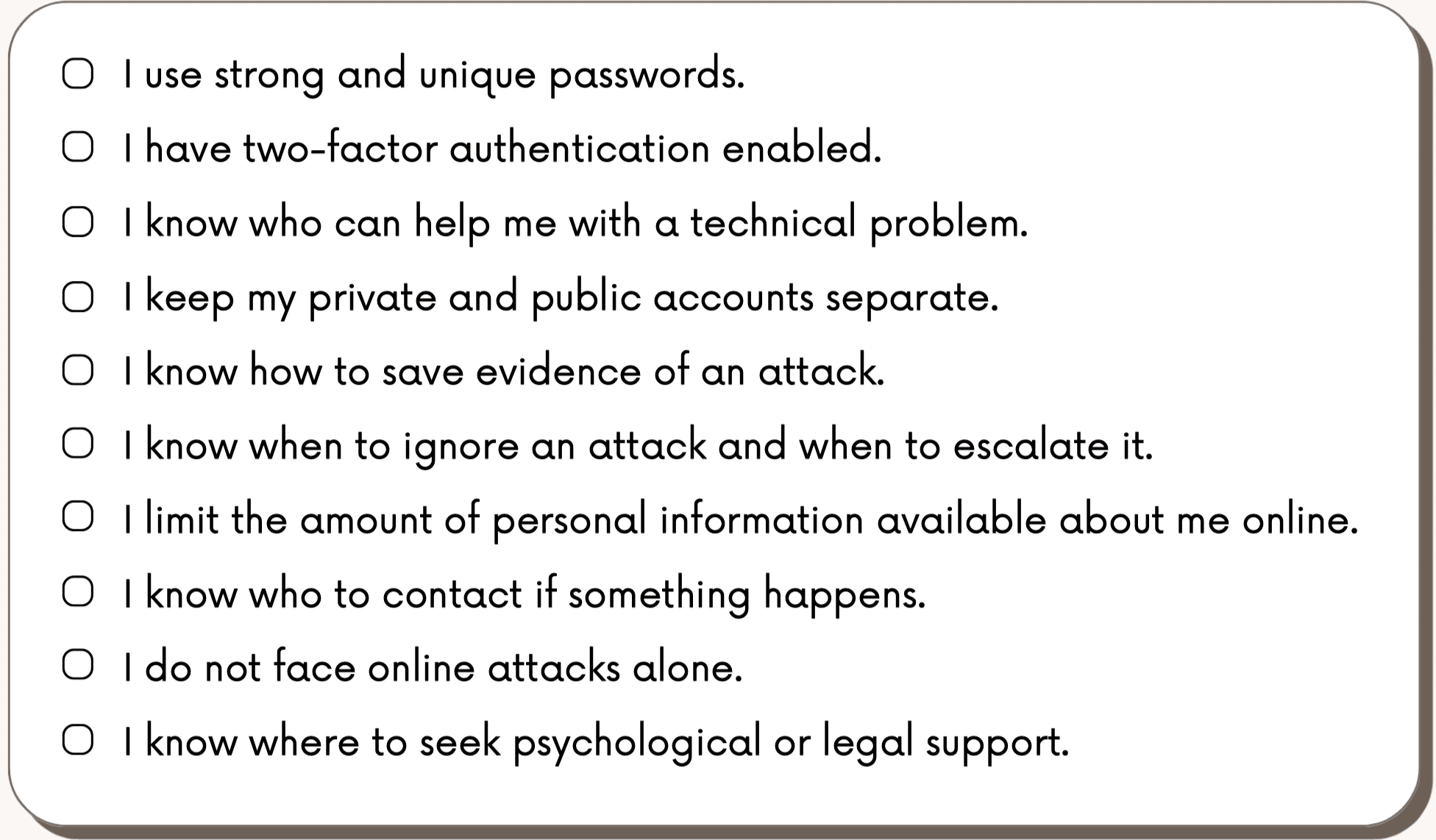
A strong emphasis is also placed on prevention - protecting accounts, enabling two-factor authentication, conducting privacy audits, and limiting the amount of publicly available personal information.
#The most common forms of attacks
#When Is It More Than Ordinary Criticism?

#What to Do in the First 30 Minutes After an Attack?
#Protect Your Accounts and Devices
#Not every response needs to be public
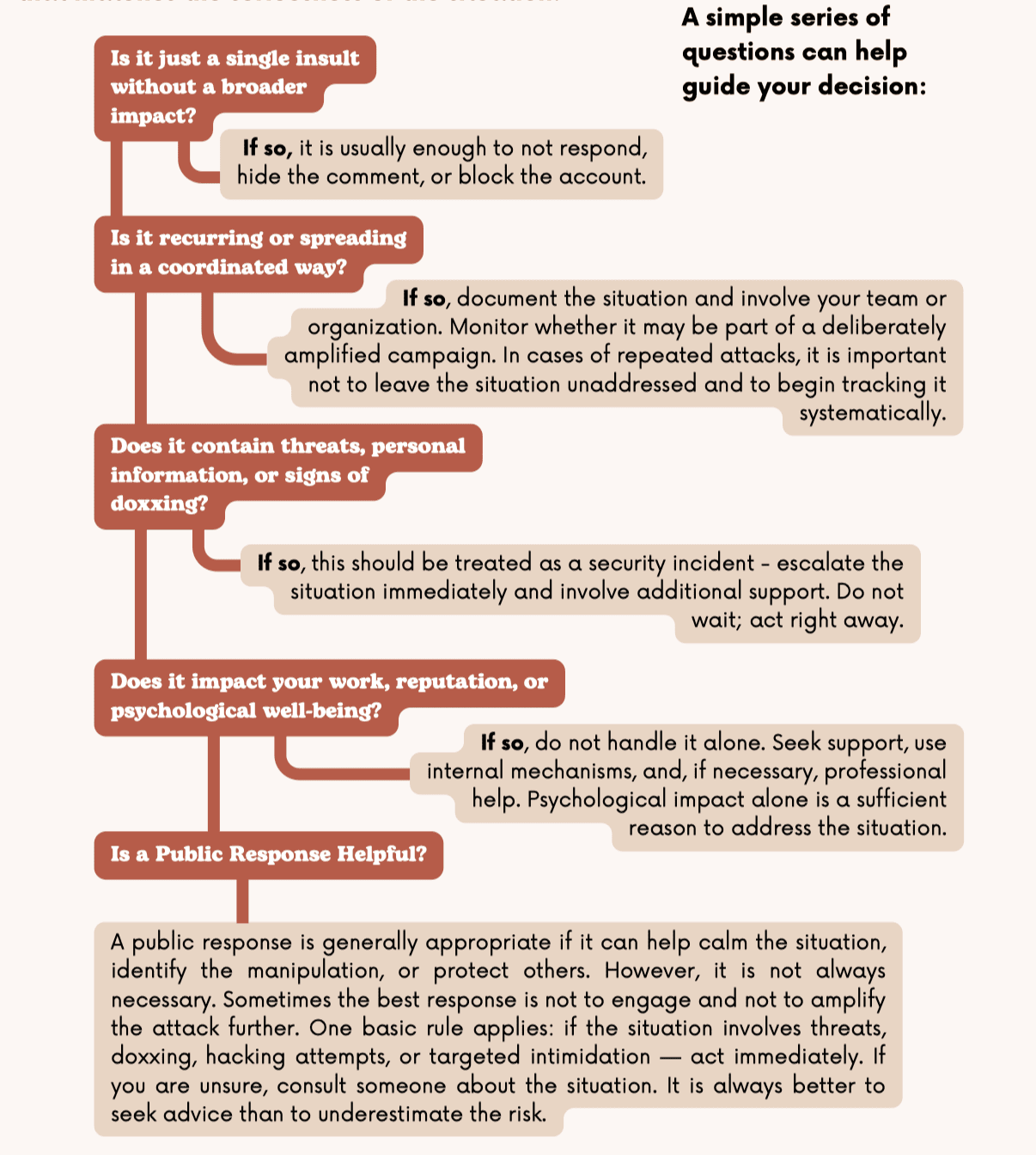
One important topic covered in the guide is public responses. The publication points out that not every attack requires an answer, and sometimes the best response is not to engage at all. The key is that the response should protect the targeted person - not reinforce the logic of the attack.
The guide, therefore, offers a simple decision-making model based on three questions:
Will my response help clarify or calm the situation?
Will my response unnecessarily amplify the attack?
Do I have the capacity and a safe environment to respond?
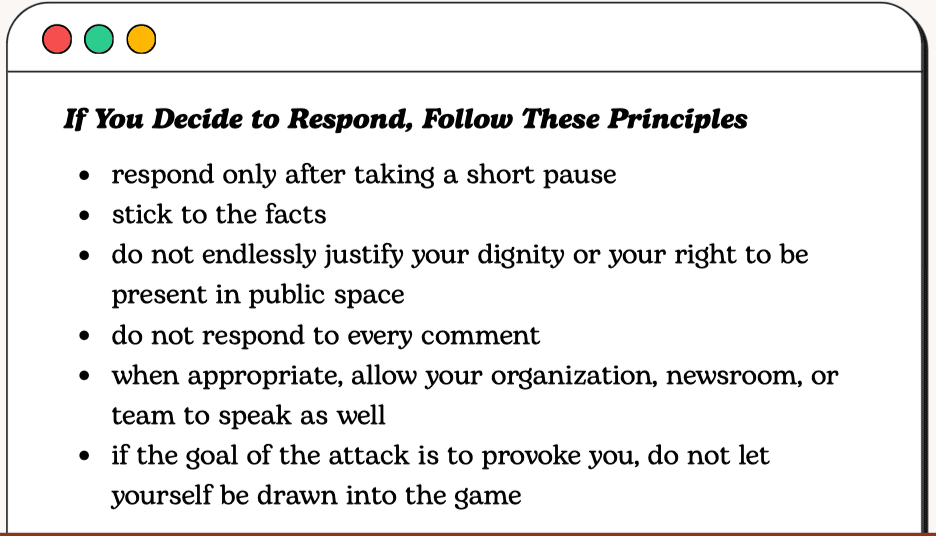
If a woman decides to respond, the guide emphasizes the importance of sticking to facts, avoiding impulsive reactions, and refusing to be drawn into manipulative games.
#When to Respond Publicly — and When Not To
#If You Decide to Respond, Follow These Principles
#Questions to Ask Before Responding

#Safety is also teamwork
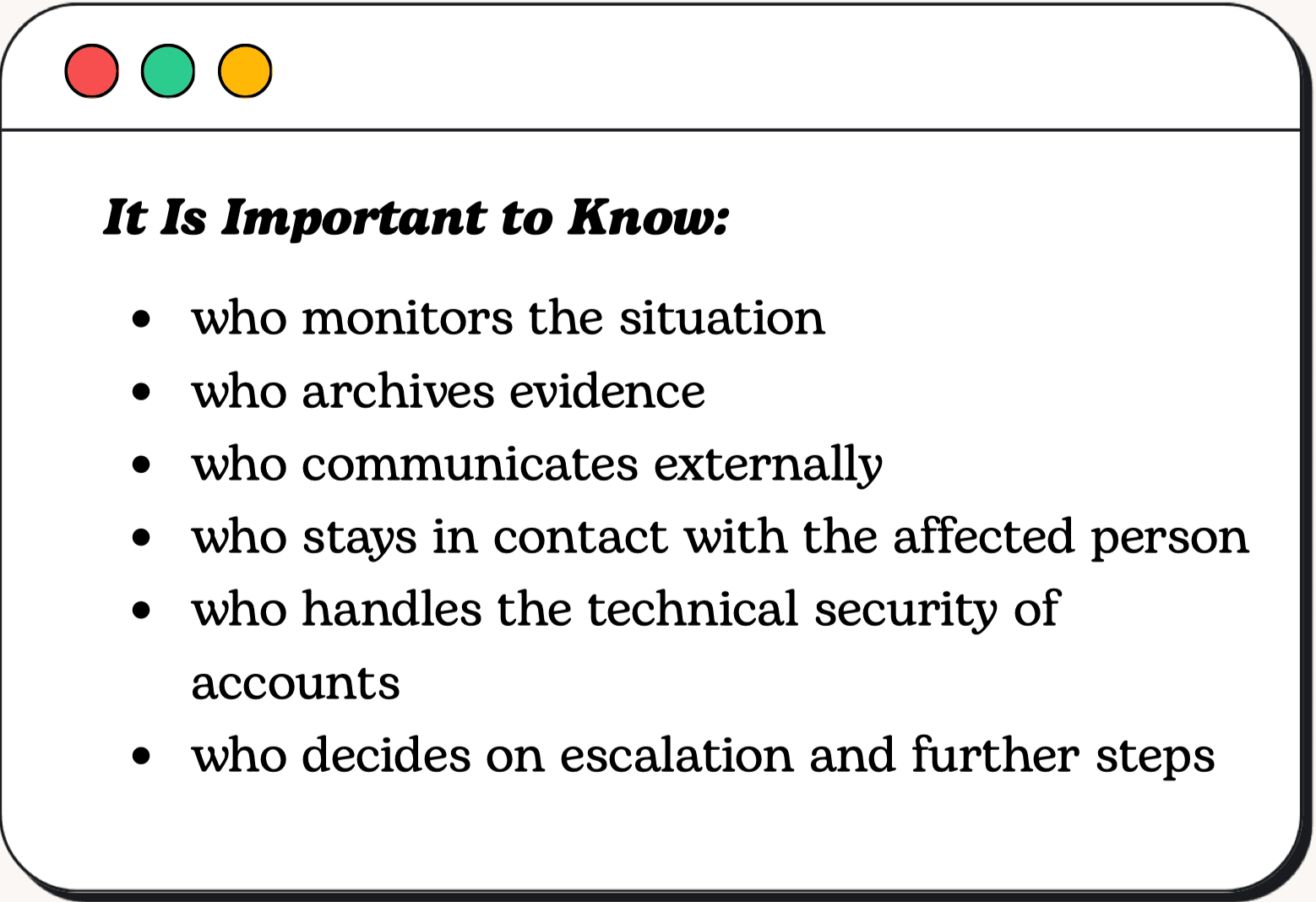
The publication highlights that online attacks should not remain solely an individual problem. Newsrooms, organizations, civil society initiatives, and teams can play a crucial role by helping monitor situations, archive evidence, secure accounts, and manage communication.
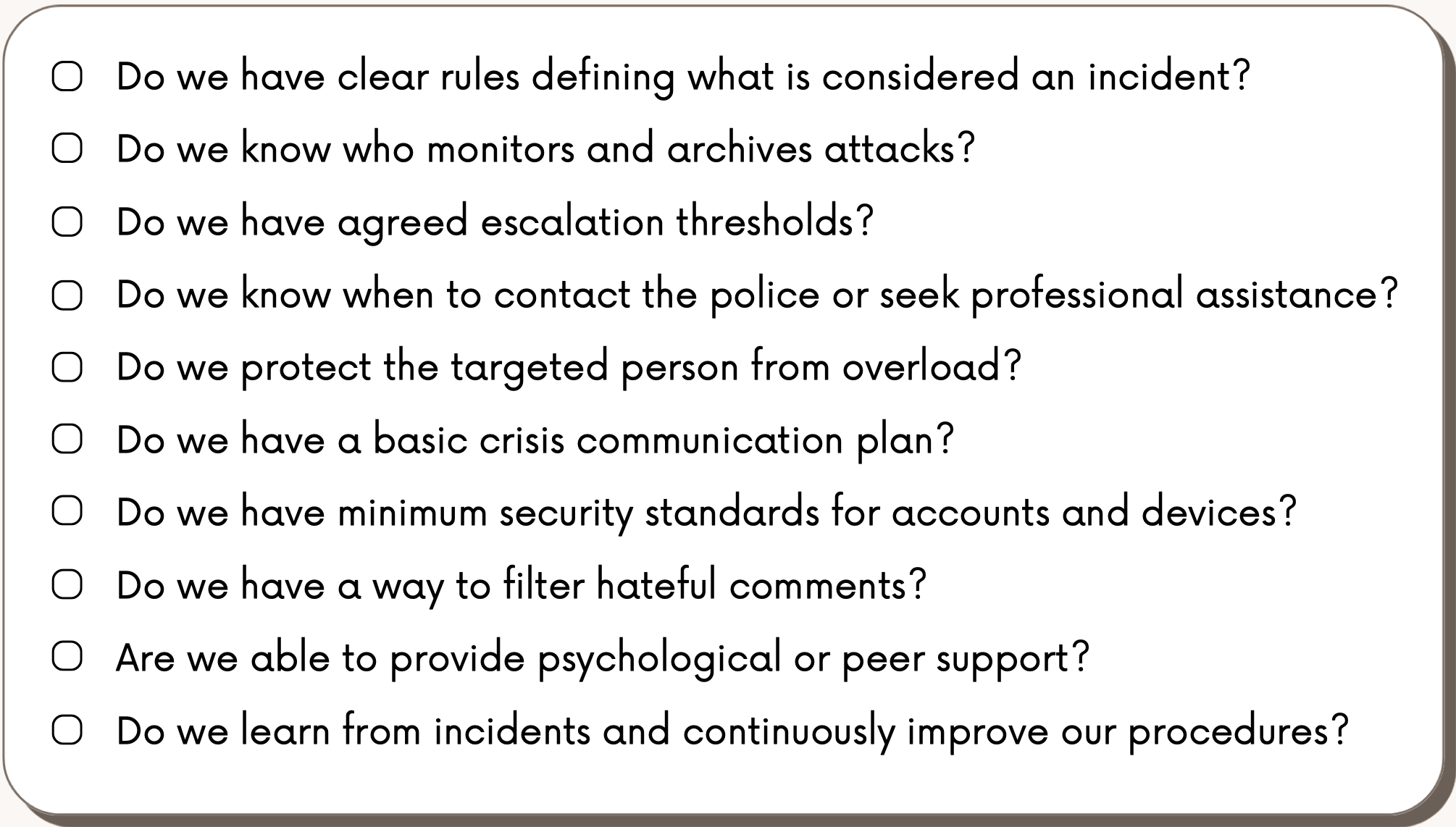
The guide therefore also includes recommendations for organizations - such as how to establish basic incident-response procedures, define escalation thresholds, and provide psychological support to targeted individuals.
A separate section focuses on mental health and coping with long-term pressure. The publication reminds readers that online attacks are not “just online” - they can significantly affect psychological well-being, work, and a sense of security.
#When an Attack Targets a Team or Organization
#Psychological Support Is Part of Safety

#Is Our Organization Prepared?
#Long-term resilience against manipulative attacks
The authors stress that digital safety is not a one-time setting, but a long-term process of building resilience. This includes regular education on digital security, sharing experiences among women in public life, supporting peer networks, and identifying harmful narratives before they become normalized in online spaces.
The guide is also based on the belief that public space belongs to women as well, and that safety should not be seen as an obstacle to participation in public life, but as a fundamental condition for freedom and democratic participation.
#My Personal Safety Checklist
#About the guide
The publication was prepared by Rasťo Kužel, Marek Mračka, and Alexandra Bitušíková. It draws on international recommendations and research by organizations such as UNESCO, OSCE/ODIHR, the United Nations, PEN America, and the Committee to Protect Journalists, as well as on the joint research of MEMO 98 and Women in Media on gendered disinformation in Slovakia and Czechia.
The guide is accompanied by the joint research report by MEMO 98 and Women in Media:
Online Gendered Disinformation and Politicised Gendered Abuse in Slovakia and Czechia
(full English version of the report)
The guide was produced as part of the Fighting gendered disinformation online project implemented by MEMO 98 with the support of the Embassy of the Kingdom of the Netherlands in Slovakia.